|
|
|
|
|
|
|
|
|
German First World War Aviation Art Print List
First World War Art  Aviation Art German Aviation Aviation Art German Aviation  German WW1 Aviation Print List German WW1 Aviation Print List |
[UP] - The Red Baron - Fokker Dr1 - Fokker D.VII - Fokker E.I - Fokker M.5 - Hannover CL.III - Staaken - Gotha - Albatros - AEG G.IV - Brandenburg D.I - Fokker D.II - Fokker E.II - Fokker E.III - Fokker E.V - Fokker F.I - Halberstadt D.III - Hansa-Brandenburg W.29 - Junkers J.1 - Lloyd C.V - LVG - Pfalz D.III - Rumpler 6.B - Taube - Siemens-Schuckert D.IV - Roland D.VI - Roland C.II - German WW1 Aviation Print List |
|
Listing of German WW1 Aviation Prints |
| Navigation | |
| Page 2 of 7 | Previous .. Page 2 .. Next |
|
|
|
|
|
|
|
|
|
|
|
|
|
|
|
|
|
|
|
|
|
| Navigation | |
| Page 2 of 7 | Previous .. Page 2 .. Next |
| Text for the above items : |
Oberleutnant Erich Lowenhardt by Ivan Berryman. Erich Lowenhardt was already the holder of the Knights Cross 1st and 2nd Class for acts of bravery even before becoming a pilot. After serving as an observer for a year, he was eventually posted to Jasta 10 in 1917 where he immediately began to score victories, sending down balloons and enemy aircraft at a fearsome rate. He was appointed Commander of Jasta 10 one week before his 21st birthday, making him one the youngest pilots to rise to such a rank in the German Army Air Service. He continued to increase his score steadily throughout 1917 and 1918, but was involved in a mid-air collision with a Jasta 11 aircraft on 10th August. Lowenhardt elected to abandon his aircraft, but his parachute failed to deploy and the young ace fell to his death. He flew a number of aircraft, but this yellow-fuselaged Fokker D.VII was his most distinctive and is believed to be the aircraft in which he was killed. His final victory total was 54. |
Sopwith Camel by Anthony Saunders. The Sopwith Camel was with the mainstay of the Royal Flying Corps. It is shown here downing an Albatros over the Western Front. |
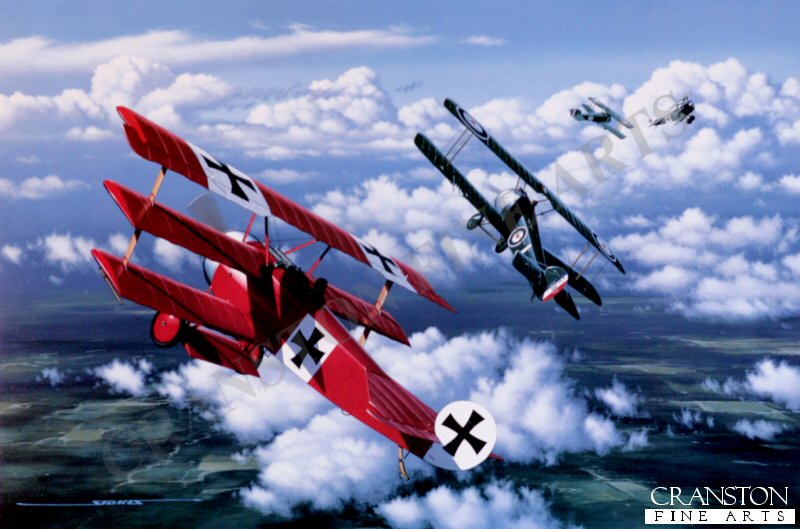
The Rittmeister by Ivan Berryman. The greatest ace of WW1, Manfred von Richthofen, the Red Baron is depicted here flying Fokker Dr.1, serial No 425/17, in its final guise following the introduction of the Balkenkreuze. This was the only Triplane flown by the Rittmeister that was painted all red and was also the aircraft in which he lost his life on 21st April 1918, the celebrated ace having scored a confirmed 80 victories against allied aircraft over France. |
Captain Roy Brown engages the Red Baron, 21st April 1918 by Ivan Berryman. Mystery still surrounds just why Manfred von Richthofen risked so much in chasing the novice pilot Wilfred Wop May into Allied-occupied territory on the morning of Sunday, 21st April 1918, but it was to be his last flight, this error of judgement costing him his life. Von Richthofen had broken from the main fight involving Sopwith Camels of 209 Sqn to chase Mays aircraft, but found himself under attack from the Camel of Captain Roy Brown. All three aircraft turned and weaved low along the Somme River, the all red Triplane coming under intense fire from the ground as well as from Browns aircraft. No one knows exactly who fired the crucial bullet, but Manfred von Richthofens aircraft was seen to dive suddenly and impact with the ground. The Red Baron was dead and his amazing run of 80 victories was over. The painting shows Mays aircraft (D3326) in the extreme distance, pursued by DR.1 (425/17) and Browns Camel (B7270) in the foreground. |
Alone in a Winter Sky - Fokker Triplane DR1 by David Pentland. Rittmeister Karl Bolle Commander Jasta 2 early 1918. |
1st Lieutenant Paul Baer by Ivan Berryman. The outstanding qualities of the Spad S.VII were exploited to the full by Lieutenant Paul Baer, who was to become the first ace of the United States Air Service whilst serving with the 103rd Pursuit Squadron. This former Lafayette Flying Corps volunteer is also recorded as the highest-scoring Spad pilot in the USAS, claiming 9 confirmed victories before being shot down on 22nd May 1918 and being taken prisoner. His aircraft is shown here in combat with Albatross scouts of Jasta 18. |
Sergeant John H Jones and pilot Captain W G Mostyn, Bristol F2b Fighter claiming a Luft-Verkehrs-Gesellschaft LVG by Ivan Berryman. Of similar configuration, but usually outclassed by its British contemporary, the Bristol F2b, the Luft-Verkehrs-Gesellschaft LVG was essentially a strong and stable observation aircraft that served widely during World War 1. On 21st May 1917, this example became the victim of the guns of Sergeant John H Jones, contributing to his eventual tally of 15 victories. Here, his pilot that day, Captain W G Mostyn, has already had a squirt using his forward-firing Vickers gun before manoeuvring their 22 Sqn machine into position for Jones to finish the job with his twin Lewis guns. |
The Ringmaster by Stan Stokes. Born in Prussia to wealthy aristocratic parents, Manfred Freherr von Richtofen, The Red Baron, was to become the top ace of World War I, with 80 confirmed kills, and probably another 40-50 which took place over enemy lines and could not be confirmed. Richtofen was originally a cavalry officer, but with great persistence he was transferred to the air arm. After a brief period on the eastern front Richtofen was transferred to the western front in August 1915. His first confirmed victory was recorded in September 1916 and by November he recorded eleven kills, including Major Lance Hawker, the top British fighter pilot. With his keen reflexes and eyesight he quickly ascended, and by June 1917 Richtofen took control of a unit near Coutrai. This unit became known as Richtofens Circus. By July the ringmaster had his fifty-seventh victim. Despite his successes Richtofen shunned publicity and became increasingly withdrawn. Richtofen was wounded in combat and spent three weeks in the hospital recuperating. After his return to duty Manfred became a vocal proponent of the Fokker triplane. The bright red paint scheme utilized on one of Richtofens aircraft is what earned him the nick-name, The Red Baron. Richtofens brother, Lothar, was also an ace with forty victories to his credit. By April of 1918, aided by Americas entry into the War, Germany was facing overwhelming numbers of enemy aircraft, and many with performance capabilities the equal to, and in some cases superior to, their own. The Germans mounted a final desperate offensive, and on April 21,1918 The Red Baron finally fell victim to the perils of combat. Although there is considerable controversy over the Red Barons demise, it appears that Richtofen was either killed by Captain Arthur Brown, a Canadian flying with the RAF, or was shot down by Australian machine gunners while evading Captain Brown. Richtofen was provided a full military funeral by the Allies, and on the evening following his funeral a single RAF fighter dropped a small package containing photos of the funeral onto the Circus headquarters. By Wars end the Circus was credited with the destruction of 644 aircraft, but 56 of its airmen had been killed, 32 seriously wounded, and 6 captured. Richtofen is pictured in July of 1917 tangling with Sopwith Camels in the skies over Belgium. Flying his beloved Fokker triplane, the infamous Red Baron is shown positioning his aircraft for yet another victory. |
Brothers in Arms by Ivan Berryman. On the morning of 13th April 1917, five RE8s of 59 Sqn, RFC, took off from their base at La Bellevue on a photographic sortie, A3203 carrying a camera, with the other four flying as escorts. Spads of 19 Sqn and some 52 Sqn Fe.2s were to have joined them as fighter cover, but the rendezvous was never made and the RE8s found themselves alone. For some unknown reason, this flight of aircraft seemed to have drifted some way north of their intended target - and into the clutches of a group of Jasta 11 Albatros scouts, led by none other than Baron Manfred von Richthofen. In a relatively short combat, all five RE8s were shot down by their German opponents, one by the Red Baron himself and two by his brother, Lothar, who claimed his fourth and fifth victims, thus becoming an ace, the others being downed by Festner and Wolff in similar aircraft. For the Red Baron, this was a day of particular significance. Not only had he now scored more victories than his mentor, Oswald Boelcke, by shooting down his 41st victim, he was later to claim a further two victories that same day - his first triple. He is depicted here flying Albatros D.III Nr.2253/17. |
Kleiner Freund - Zeppelin Staaken R.VI by Ivan Berryman. With a wingspan of 42.2 metres, the mighty Zeppelin Staaken series of bombers were truly awesome, living up to their name Riesenflugzeug - Giant Aircraft. Unusually for this period, the crew compartment of the R VI was fully enclosed and the bomb load was carried internally. The four engines were mounted in tandem pairs, two pushing and two pulling, which eliminated the need for complex gearing, and the flight engineers sat in cockpits in the engine nacelles. This example is shown limping home, its rear port engine stopped and smoking, escorted by its Little Friend, an Albatros D.V. The painting shows the Staaken bomber is quite badly shot up. There are bullet holes all over the port wings, tailplane and rudder, as well as the engine trailing smoke from a small oil fire in the nacelle, which the engineer is keeping an eye on. |
Kurt von Crailsheim by Ivan Berryman. The Fokker E II of Leutnant Kurt Freiherr von Crailsheim of FFA 53 is shown in formation with his wingman in a similar aircraft. Von Crailsheims aircraft bears his personalised markings of yellow, black and white diagonal bars on the fuselage, thought to represent his Military Merit Medal combined with the black and white of Prussia. The cross on the fuselage sides was applied in an unusually forward position. FFA 53 was based at Monthois late in 1915 and it was from this location that von Crailsheim made his final flight in this aircraft on 30th December. |
A Zeppelin over London by Ivan Berryman. From 1915 to 1917, there existed a very real threat of a bombing campaign on mainland Britain as the giant German airships drifted silently and menacingly across the English Channel and the North Sea to deliver their deadly cargo on the towns and cities of the east coast. Countermeasures were soon put into action as powerful searchlights picked out the Zeppelins for the anti-aircraft batteries and RFC pilots to pour their unrelenting fire into the raiders, sometimes with little effect, sometimes with catastrophic results. Here, 2nd Lieutenant Brandons BE.2 climbs for position, its exhaust pipes aglow in the dark, whilst flak bursts all around the massive bulk of the L.33 as she passes over the east end of London on the night of 23 / 24th September 1916. |
Etrich Taube by Ivan Berryman. The extraordinary Taube (or Dove) was extensively used by the Germans as a reliable, stable observation and reconnaissance aircraft as late as 1916, despite its archaic appearance. The Taube type first flew in Austria in 1909, the brainchild of Dr Igo Etrich and employed the early method of directional control known as differential wing-warping, instead of possessing ailerons and elevators. This version was powered by a Mercedes 6-cylinder inline engine and is a two-seat variant, much favoured by the Germans. |
Leutnant Wolfram von Richthofen by Ivan Berryman. The aerial battle of 21st April 1918 was notable for involving two young novice pilots, each from opposing sides, and their part in the events that followed was as significant as it was tragic. Both William Wop May and Wolfram Ulf von Richthofen had been instructed to stay out of trouble, to remain on the very outskirts should a battle occur and simply get used to being in the sky with so many other aircraft. Delighted to have been assigned to Jasta 11 under the custodianship of his older, eminent cousin, Manfred, Wolfram was eager to cut his teeth and show that he, too, could get the job done. Both he and May kept a watchful vigil over proceedings from a safe distance as battle was joined between the red-nosed Fokker DR.1s of Jasta 11, the green-tailed Albatrosses of Jasta 5 and the RFC Sopwith Camels of 209 Squadron. Somehow, whether through carelessness or the adrenalin rush of the moment, Wolfram flew his Fokker tantalisingly close to Mays Camel who immediately gave chase, sensing that an easy first kill might just be a possibility. May quickly realised that all was not well, however, finding his guns jammed and unable to fire. He quickly broke off the attack and swooped away, but his actions had caught the attention of Manfred von Richthofen who, although engaged in a battle of his own, had been keeping a watchful eye over his young charge. The red Triplane now latched onto the tail of Mays helpless Camel and a lurid chase began along the Somme River, a chase from which the Red Baron would not return. The young Wolfram went on to become an ace, scoring all of his eight victories in the closing months of the war, was awarded the Iron Cross 1st and 2nd and survived to be a major force in Hitlers Luftwaffe in World War Two. He was eventually taken prisoner and spent his last months in an American PoW camp where he died of a brain tumour in 1945. |
Rumpler 6.B by Ivan Berryman. Based on the two-seat Rumpler C.1, the 6.B was an elegant single-seat fighter with a top speed of 153 km/h and a range of four hours flying time. Armament was a single Spandau synchronised machine gun mounted on the port side of the Mercedes D.III engine. Quite modern-looking by the standards of the day, it was introduced into service in 1916, but large scale production was never undertaken and fewer than 100 examples of the 6.B-1 and 6.B-2 were built. The type did however enjoy a long service career with both the German and Finnish air forces, some serving until as late as the 1920s. |
AGO C.1 by Ivan Berryman. At the outbreak of World War 1, AGO Flugzeugwerke GmbH had not endeared itself to the architects of the German war machine due to the flimsiness of some of its designs, coupled with poor workmanship. When the C.1 first appeared in 1915, it attracted little interest and yet went on to prove itself to be a robust and useful aircraft, its pusher design dispensing with the now traditional open framework to support the tail in favour of twin streamlined tailbooms. The observer / gunner in the nose enjoyed an unrivalled field of view, although the engines position immediately behind the pilot was always a concern in the event of a crash. This aircraft, LF181, transferred from the Fliegertrouppe to the navy in 1915 and was based at Nieuwmunster, shown here in an exchange with an FE.2b in the skies over Belgium. |
The Fokker Scourge by Stan Stokes. Anthony Herman Gerard Fokker was born in the Dutch East Indies in 1890. When his father retired the Fokker family returned to Holland, where Anthony attended school. He dropped out of college, and being deemed unfit for military service, worked at a number of odd jobs. Fokkers father persuaded his son to attend an automobile mechanics school in Germany, but Anthony was disappointed and convinced his father to enroll him in a school near Mainz which offered courses in aircraft construction and flying. This endeavor was not particularly successful, and Anthony decided to build his own flying machine. He found a partner in Oberlieutenant Von Daum, a fifty-year-old officer in the German military. The aircraft was completed in 1910, and Fokker flew it successfully on a number of flights. Von Daum, unfortunately, destroyed the machine on his first attempt at flying it. The two partners then teamed with a boat-builder to construct a second aircraft. In early 1912 Anthony had organized Fokker Aviatik GmbH with money advanced from his father. Fokker won his first contract for military aircraft in July 1913. Fokker became interested in the design of the Moraine-Saulnier, which exhibited flying characteristics far superior to the early Fokker designs. The Fokker M.5 (Eindecker I) emerged from the reengineering of a damaged Moraine-Sualnier. With the outbreak of WW I, the German military ordered large numbers of this aircraft for use as a scout. These Fokker scouts were good machines and well-liked by the pilots that flew them. Early in 1915 the French equipped their scouts with forward firing machine guns, and German losses in aerial combat increased sharply. The French system was simplistic and utilized shields on the propeller to deflect soft copper shells. Anthony Fokkers company was the first to introduce a workable machine gun synchronizer which would allow steel bullets to be used. The German military ordered the new Fokker fighter in large numbers, and by late 1915 the tide had shifted dramatically in favor of the Germans. The British press coined the term Fokker Scourge to describe this new menace which was increasing casualties to unprecedented numbers. Oswald Boelcke, and Max Immelmann were two German pilot aces who became very popular. Immelmann is depicted in Stan Stokes painting executing the aerial maneuver which took his name. Immelman received the Blue Max (Pour le Merite) to add to his Iron Cross following his eighth victory on January 12, 1916. He would officially be credited with fifteen victories prior to his death in June of 1916. The Germans maintained that a defective gun synchronizer caused Immelmann to shoot off his own propeller. |
The Biff Boys by Robert Taylor. On the morning of 30th November 1917, Lieutenant Andrew McKeever, a Canadian serving with 11 Squadron RFC, together with his observer/gunner Lieutenant Leslie Powell, climbed into their Bristol F2b Fighter and took off alone; their task to fly a solo reconnaissance patrol over Cambrai, where the decisive battle involving tanks for the first time in history was raging on the ground below - it was to prove a remarkable day. As they flew over the enemys lines they encountered a pair of German two seater observer aircraft, protected by no fewer than seven enemy Albatross DV scouts. Armed with a forward firing .303 Vickers machine gun and a ring mounted Lewis gun in the back seat, McKeever skilfully manoeuvred his aircraft to engage one of the enemy scouts, and destroyed it. As he turned to get back to the Allied lines, five of the remaining enemy Albatross fighters dived on his tail, but Lt Powell rapidly downed two of them in quick succession with deadly fire from his Lewis gun. Continuing the duel with the remaining Germans, McKeever managed to destroy a further Albatross when suddenly his observers Lewis gun jammed. The pair seemed doomed, however McKeever, showing great courage and initiative, feigned disaster by rolling his aircraft over, plummeting it towards the ground. Fooled by the manoeuvre, the German aircraft climbed away, and McKeever levelled out just twenty feet above the ground and flew back to safety. Remarkably, all of McKeevers thirty one victories were achieved at the controls of the Bristol F2b Fighter, making him the highest scoring ace with 11 Squadron, and of any pilot flying two seater aircraft during the First World War. |
The Greatest of Them All - Manfred von Richthofen by Ivan Berryman. Arguably the best known of all World War 1 fighter aces, Manfred von Richthofen, the 'Red Baron', is depicted here flying Fokker Dr.1, serial No 425/17, in its final livery following the introduction of the Balkenkreuze, early in 1918. Contrary to popular belief, this was the only Triplane flown by the Rittmeister that was painted all red and was also the aircraft in which he lost his life on 21st April 1918, the celebrated ace having scored a confirmed 80 victories against allied aircraft over France. |
One in the Bag by Ivan Berryman A German Albatross D-III sees off a Bristol Fighter among the clouds over the Western Front, early in 1917. The D-III was a massive improvement over the monoplanes of the time, possessing greater manoeuvrability, a higher ceiling and synchronized guns. Many German aces thought this the best fighter of the First World War. |
Captain Ivan Smirnov by Ivan Berryman. After service in the 96th Infantry Regiment, Smirnov joined the XIX Corps Air Squadron in 1914, shooting down twelve enemy aircraft in the course of two years. When revolution swept through Russia in November 1917, he escaped the Bolsheviks via a White counter-revolutionary route, eventually joining the RAF in England, serving at the Central Flying School at Upavon. He is shown here in his silver Nieuport 17, having just despatched a Roland C.II. |
|
Contact Details |
|
Sign Up To Our Newsletter!
This website is owned by Cranston Fine Arts. Torwood House, Torwoodhill Road, Rhu, Helensburgh, Scotland, G848LE Contact: Tel: (+44) (0) 1436 820269. Email: cranstonorders -at- outlook.com
|
 |