|
|
|
|
|
|
|
|
|
The Red Baron
First World War Art  Aviation Art German Aviation Aviation Art German Aviation  The Red Baron The Red Baron |
[UP] - The Red Baron - Fokker Dr1 - Fokker D.VII - Fokker E.I - Fokker M.5 - Hannover CL.III - Staaken - Gotha - Albatros - AEG G.IV - Brandenburg D.I - Fokker D.II - Fokker E.II - Fokker E.III - Fokker E.V - Fokker F.I - Halberstadt D.III - Hansa-Brandenburg W.29 - Junkers J.1 - Lloyd C.V - LVG - Pfalz D.III - Rumpler 6.B - Taube - Siemens-Schuckert D.IV - Roland D.VI - Roland C.II - German WW1 Aviation Print List |
|
Manfred Von Richthofen, The Red Baron in aviation art prints. Manfred Von Richthofen, Germanys tops first world's war Fighter ace with 80 victories. is shown in aviation art prints by the worlds leading aviation artists, Ivan Berryman, Gerald Coulson, Graeme Lothian, Nicholas Trudgian and Tim Fisher. These original oil paintings of art prints of The red baron are only available direct form from Cranston Fine arts and Our website's at these great prices. Richthofen was
born in Kleinburg, near Breslau, Silesia (now Poland) on the2nd May
1892. After schooling at Schweidnitz, Manfred Von Richthofen began
his military cadet training at the 11.
In 1911 after completing training he joined
the Uhlan regiment 1st West Prussian regiment . When war
broke out Richthofen was serving
as a cavalry reconnaissance officer on both the Eastern front and western
front. Disappointed that he could not take part
in more combat situations he transferred to the Imperial German Army
Air Service in May 1915. First serving as an observer on reconnaissance flight
on the Eastern front with Fliegerabteilung 69.
Once transferred to the Champagne front
Richthofen shot down a French Farmen aircraft with his observer machine
gun. This was not credited as a kill as it could not be confirmed. In march 1916 after completing Pilot training he joined Kampfgeschwader 2 flying a two seater Albatros C.111. On the 26th April 1916 he shot down a French Nieuport over Fort Douaumont, but again as it was shot down behind enemy lines it was not credited as a kill. For a spell Richthofen flew a Fokker Eindecker before returning to the eastern Front. It was here he first meet the German ace Oswald Boelcke in August 1916. who selected Richthofen to join the new fighter squadron Jagdstaffel 2 and over Cambrai on the 17th September 1916 Richthofen scored his first victory. The red baron would go onto become the highest scoring ace with a total of 80 victories. But Richthofen was killed just after 11 a.m. on 21 April 1918, while flying over Morlandcourt Ridge near the Somme River |
| Navigation | |
| Page 1 of 2 | Page 1 .. Next |
|
|
|
|
|
|
|
|
|
|
|
|
|
|
|
|
|
|
|
|
|
| Navigation | |
| Page 1 of 2 | Page 1 .. Next |
| Text for the above items : |
Final Days by Ivan Berryman. Fokker DR.1 Triplane 425/17 of Manfred von Richthofen, accompanied by a Fokker. D.VII wingman, swoops from a high patrol early in 1918. 425/17 was the aircraft in which the Red Baron finally met his end in April of that year, no fewer than 17 of his victories having been scored in his red-painted triplane. |
Last But One by Ivan Berryman. In the skies just west of Amiens on 20th April 1918, the celebrated German ace, Manfred von Richthofen, the Red Baron, flying his famous all-red Fokker DR.1 Triplane 425/17 and accompanied by other DR.1s of his notorious Flying Circus, encountered Sopwith Camels of No.3 and No.201 Squadrons and a fierce aerial battle ensued. Two Sopwith Camels were to fall to the Red Baron's guns that day, the first of them being Major Richard Raymond-Barker, shown here flicking his aircraft to the right to avoid the German's fire. Raymond-Barker was almost immediately shot down, his burning aircraft being consumed by fire on impact. Just minutes later, Second Lieutenant David Lewis was caught and despatched, these two British scouts being the last ever victims of Baron von Richthofen. |
Manfred Von Richthofen c.1917 by Chris Collingwood. No text for this item |
Knights of the Sky by Nicolas Trudgian The dramatic scene depicts an aerial dog-fight between Sopwith Camels and SE5A fighters of the Royal Flying Corps, and the bright red planes of Baron von Richthofens JG1 fighter wing. High over Northern France, the highly manoeuvrable fighters wheel and turn in the cauldron of close aerial combat, the artist bringing alive that evocative era when aerial combat first began. |
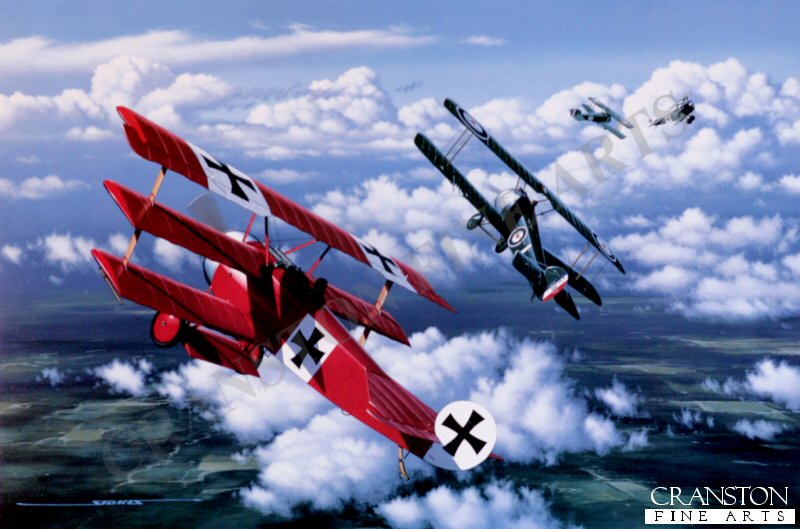
In For The Kill by Ivan Berryman. Von Richthofens Fokker DR 1 Triplane (Serial No 425/17) in company with his wingman in a Fokker D.VII over the fields of the Western Front early in April 1918, peeling off to attack a flight of three British fighters. |
Master of the Skies by Tim Fisher. Von Richthofen brings down Ronald Hinings of 73 Squadron, making his 78th victory. This painting depicts the battle between Manfred von Richthofen and Lieutenant Ronald George Adams of 73 Squadron. Since his arrival on the battlefield in the late summer of 1916, this made Richthofen's 78th victory out of a final total of 80. The aircraft he was flying was a Fokker Drl No 477/17. It is shown with red upper wing surfaces, tail plane, rudder and wheel covers. National markings were in the process of change in March/April 1918. There is no evidence of the precise date of change and so 477/17 is shown with its original Cross Patee markings. |
Dawn Dog Fight, Mick Mannock VC by Graeme Lothian. High above the trenches in April 1918, 74 Squadron engage the famed JG 1 led by the renowned ace baron von Richthofen in his distinctive bright red DR 1. Edward Mick mannock flying a SE5.a diving down top engage another Fokker Dr1 as the red baron flies past momentarily catching each others eyes. The new CO of 74 squadron, major Grid Caldwell MC (bar) New Zealands top ace can be seen above entering the dog fight. But it would be Mannock who would go on to great fame. with 61 confirmed victories and to win the VC, DSO (bar) and MC (bar) After 74 squadron he replaced Billy Bishop of CO 85 Squadron on the 3rd July 1918, scoring 46 victories in the Se5.a He was killed by ground fire near Lestram, France on the 26th July 1918. his Victoria Cross being gazetted on the 18th July 1919. The red baron CO of the Richthofen's Flying circus didn't survive the month, also killed by ground fire on the 21st April, he was buried by the Allies with full military honours. |
The Greatest of Them All - Manfred von Richthofen by Ivan Berryman. Arguably the best known of all World War 1 fighter aces, Manfred von Richthofen, the 'Red Baron', is depicted here flying Fokker Dr.1, serial No 425/17, in its final livery following the introduction of the Balkenkreuze, early in 1918. Contrary to popular belief, this was the only Triplane flown by the Rittmeister that was painted all red and was also the aircraft in which he lost his life on 21st April 1918, the celebrated ace having scored a confirmed 80 victories against allied aircraft over France. |
Brief Encounter by Gerald Coulson. Royal Flying Corps SE5As of 56 squadron engaged in air combat with flying circus Fokker Dr1s commanded by the great German ace Baron von Richthofen, France 1917. |
The Brothers Richthofen by Stan Stokes. Arguably the best brother team of two fighter aces was Manfred and Lothar von Richtofen, with 120 WW I aerial victories between them. Manfred, who became known as The Red Baron, was the top ace of WW I and his reputation is still alive and well today thanks to movies and books. The Richtofen family was minor nobility, and Manfred painted the aircraft he flew in the squadron he commanded bright red - hence the name Red Baron. Manfred was born in Poland in 1892, and was sent to military school at age eleven. When WW I commenced Manfred, commissioned as a lieutenant, initially served in the cavalry. He became enthralled with aircraft while watching planes perform aerial reconnaissance missions. In 1915 he attended flying school, and was first assigned as an observer to a bombing squadron. Inspired by the exploits of the famous ace Oswald Boelcke Manfred put in for pilot training. He passed the pilots test on his third try. He was fortunate to fly with Boelcke in Jasta 2, a unit of promising young pilots. In October of 1916 Manfred witnessed the death of Boelcke when the great ace collided in midair with one of his squadron mates. Richtofen carried Boelckes medals at the funeral, a symbolic portending of his future greatness. Richtofen began flying an Albatros D.1 with red stripes and had good success including the downing of Lanoe Hawker the first British ace of the War. By early 1917 Manfred had sixteen victories and was awarded the Blue Max. At the same time he was given command of his own unit, Jasta 11. As an incredible leader Manfred trained his pilots well in both aerial tactics and strategies. He insisted on formation flying principles and his pilots were not permitted to fly recklessly or attack without assistance. They were taught to look for situations of relative advantage whether in terms of altitude, position of the sun, or relative strength. This scientific approach made Jasta 11 one of the most successful units. It became a squadron of aces, including Ernst Udet, Werner Voss and Lothar Richtofen, Manfreds younger brother. JG 1, a group of four Jastas, was organized in June of 1917 with Manfred as its Commander. With all the planes painted bright colors for identification, this unit became known as Richtofens Flying Circus. This crack unit was moved around the front as needed, and it concentrated on intercepting and destroying enemy aircraft. Very little reconnaissance or escort missions were flown. The unit attained between June 1917 and November 1918 an incredible 644 aerial victories compared to the loss of only 52 of its own aircraft. The Fokker Dr. 1 triplane was deployed with JG 1 in 1917. This diminutive aircraft was too slow to be effective with pilots of ordinary skill, but in the hands of the skilled pilots of JG 1 its advantages of climbing rate and maneuverability were put to great use. Manfred attained his last 20 victories in the triplane. Manfred was downed in April of 1918 behind enemy lines. He received a full military funeral by the British. Lothar would attain 40 victories - equaling Boelckes total and making him the 10th highest scoring German ace of the Great War. Lothar downed Albert Ball (the leading British ace at the time with 44 victories) in May of 1917. |
Tribute to Manfred von Richthofen by Ivan Berryman. The legendary Red Baron would score 80 confirmed victories in World War One, making him the conflict's top Ace. It was in a Fokker Dr.I - as depicted here - that he scored his final two victories, claiming two Sopwith Camels on 20th April 1918. It was in the same aircraft on the following day that he was shot down and killed. There are few pilots who gain such cultural significance as the Red Baron, still widely known more than a century after the events that gave him fame. |
Showtime at the Circus by Stan Stokes. Born in Prussia to wealthy aristocratic parents, Manfred F. von Richtofen, The Red Baron, was to become the top ace of World War I, with 80 confirmed kills, and probably another 40-50 which took place over enemy lines and could not be confirmed. Richtofen was originally a cavalry officer, but with great persistence he was transferred to the air arm. After a brief period on the eastern front Richtofen was transferred to the western front in August 1915. His first confirmed victory was recorded in September 1916 and by November he recorded eleven kills, including Major L. Hawker, the top British fighter pilot at that point in time. With his keen reflexes and eyesight he quickly ascended, and by June 1917 Richtofen took control of a unit near Coutrai. This unit became known as Richtofens Circus. By July the ringmaster had his fifty-seventh victim. Despite his successes Richtofen shunned publicity and became increasingly withdrawn. Richtofen was wounded in combat and spent three weeks in the hospital recuperating. After his return to duty Manfred became a vocal proponent of the Fokker triplane. The bright red paint scheme utilized on one of Richtofens aircraft is what earned him the nickname, The Red Baron. Richtofens brother, Lothar, was also an ace with forty victories to his credit. By April of 1918, aided by Americas entry into the War, Germany was facing overwhelming numbers of enemy aircraft, and many with performance capabilities the equal to, and in some cases superior to, their own. The Germans mounted a final desperate offensive, and on April 21,1918 The Red Baron finally fell victim to the perils of combat. Although there is considerable controversy over the Red Barons demise, it appears that Richtofen was either killed by Captain Arthur Brown, a Canadian flying with the RAF, or was shot down by Australian machine gunners while evading Captain Brown. Richtofen was provided a full military funeral by the Allies, and on the evening following his funeral a single RAF fighter dropped a small package containing photos of the funeral onto the Circus headquarters. By Wars end the Circus was credited with the destruction of 644 aircraft, but 56 of its airmen had been killed, 32 seriously wounded, and 6 captured. |
Red Danger by Ivan Berryman. The Red Baron in one of his Albatross scouts instead of the Fokker DR.1 Triplane with which he is more often associated. History records that no fewer than 56 of his victims fell to the guns of a succession of Albatros scouts, so I have depicted him here flying D.III Nr.2253/17 in which he claimed (among others) victory number 52, his last in this aircraft before taking some long-overdue leave. He went on to become the highest scoring ace of World War 1 with 80 confirmed victories to his credit before his untimely death in April 1918. |
Von Richthofens Flying Circus by Ivan Berryman. No World War 1 pilot is better known than Manfred Von Richthofen, the Red Baron, and few pilots were greater exponents of the little Fokker DR.1 Triplane in which he scored nineteen of his eighty victories. In fact, only one of the DR.1s flown by von Richthofen was painted all-over Red. In April 1918, 127/17 was his mount, this machine being depicted here shortly after take off in company with other Jasta 11 pilots of his notorious Flying Circus. Among this formation are: Ltn Eberhardt Mohnicke, Ltn Hans Joachim Wolff, Rittm Manfred von Richthofen and his brother Ltn Lothar von Richthofen. The Flying Circus soubriquet was appended by the British and Canadian forces and was never used by von Richthofen or Jasta 11 themselves, but the sight of the red-nosed Triplanes as they joined battle in the skies above France signaled to Allied pilots a tough battle ahead. |
The 79th Victory by Ivan Berryman. For Manfred von Richthofen, the air battle in the skies west of Amiens on 20th April 1918 was to yield a final two victories to add to the seventy eight with which he was already credited. But these were to be his last, the Red Baron finally succumbing the following day. Just moments before Second Lieutenant David Lewis' 3 Sqn Sopwith Camel fell to the German's guns (the young pilot surviving to tell his story of being the Red Baron's final victim), Major Richard Raymond-Barker was not so lucky, his aircraft burning furiously until it hit the ground in a fireball near the Forest of Hamel. |
Captain Roy Brown engages the Red Baron, 21st April 1918 by Ivan Berryman. Mystery still surrounds just why Manfred von Richthofen risked so much in chasing the novice pilot Wilfred Wop May into Allied-occupied territory on the morning of Sunday, 21st April 1918, but it was to be his last flight, this error of judgement costing him his life. Von Richthofen had broken from the main fight involving Sopwith Camels of 209 Sqn to chase Mays aircraft, but found himself under attack from the Camel of Captain Roy Brown. All three aircraft turned and weaved low along the Somme River, the all red Triplane coming under intense fire from the ground as well as from Browns aircraft. No one knows exactly who fired the crucial bullet, but Manfred von Richthofens aircraft was seen to dive suddenly and impact with the ground. The Red Baron was dead and his amazing run of 80 victories was over. The painting shows Mays aircraft (D3326) in the extreme distance, pursued by DR.1 (425/17) and Browns Camel (B7270) in the foreground. |
Richthofens Flying Circus by Nicolas Trudgian. Nicolas Trudgians dramatic painting recreates a scene near Cambrai, Northern France on the morning of March 18, 1918. Aware of a build-up of forces for a massive German offensive, many RFC squadrons attacked the German positions at very low altitude. Responding with as many squadrons as they could muster, including Richthofens JG1 wing, there followed one of the largest dog-fights of the entire First World War. Seen in the foreground are a Fokker Triplane and an Albatros, having winged a Sopwith Camel from 54 Squadron, as another Camel, and a Bristol fighter of 11 Squadron RFC turn to engage the German fighters. |
The Ringmaster by Stan Stokes. Born in Prussia to wealthy aristocratic parents, Manfred Freherr von Richtofen, The Red Baron, was to become the top ace of World War I, with 80 confirmed kills, and probably another 40-50 which took place over enemy lines and could not be confirmed. Richtofen was originally a cavalry officer, but with great persistence he was transferred to the air arm. After a brief period on the eastern front Richtofen was transferred to the western front in August 1915. His first confirmed victory was recorded in September 1916 and by November he recorded eleven kills, including Major Lance Hawker, the top British fighter pilot. With his keen reflexes and eyesight he quickly ascended, and by June 1917 Richtofen took control of a unit near Coutrai. This unit became known as Richtofens Circus. By July the ringmaster had his fifty-seventh victim. Despite his successes Richtofen shunned publicity and became increasingly withdrawn. Richtofen was wounded in combat and spent three weeks in the hospital recuperating. After his return to duty Manfred became a vocal proponent of the Fokker triplane. The bright red paint scheme utilized on one of Richtofens aircraft is what earned him the nick-name, The Red Baron. Richtofens brother, Lothar, was also an ace with forty victories to his credit. By April of 1918, aided by Americas entry into the War, Germany was facing overwhelming numbers of enemy aircraft, and many with performance capabilities the equal to, and in some cases superior to, their own. The Germans mounted a final desperate offensive, and on April 21,1918 The Red Baron finally fell victim to the perils of combat. Although there is considerable controversy over the Red Barons demise, it appears that Richtofen was either killed by Captain Arthur Brown, a Canadian flying with the RAF, or was shot down by Australian machine gunners while evading Captain Brown. Richtofen was provided a full military funeral by the Allies, and on the evening following his funeral a single RAF fighter dropped a small package containing photos of the funeral onto the Circus headquarters. By Wars end the Circus was credited with the destruction of 644 aircraft, but 56 of its airmen had been killed, 32 seriously wounded, and 6 captured. Richtofen is pictured in July of 1917 tangling with Sopwith Camels in the skies over Belgium. Flying his beloved Fokker triplane, the infamous Red Baron is shown positioning his aircraft for yet another victory. |
Manfred and Lothar von Richthofen by Darren Baker. (P) The Red Baron, Manfred von Richthofen, observes aircraft with his younger brother Lothar at a German aerodrome during the first world war. |
Baron Von Richthofen, March 1918 by Chris Collingwood. Germanys greatest First World War fighter ace, Baron Von Richthofen, known as the Red Baron is shown departing his Fokker DR.1 Triplane 425/17 after yet another successful sortie. 425/17 was the aircraft in which the Red Baron finally met his end in April of that year. No fewer than 17 of his victories having been scored in his red-painted triplane. |
Brothers in Arms by Ivan Berryman. On the morning of 13th April 1917, five RE8s of 59 Sqn, RFC, took off from their base at La Bellevue on a photographic sortie, A3203 carrying a camera, with the other four flying as escorts. Spads of 19 Sqn and some 52 Sqn Fe.2s were to have joined them as fighter cover, but the rendezvous was never made and the RE8s found themselves alone. For some unknown reason, this flight of aircraft seemed to have drifted some way north of their intended target - and into the clutches of a group of Jasta 11 Albatros scouts, led by none other than Baron Manfred von Richthofen. In a relatively short combat, all five RE8s were shot down by their German opponents, one by the Red Baron himself and two by his brother, Lothar, who claimed his fourth and fifth victims, thus becoming an ace, the others being downed by Festner and Wolff in similar aircraft. For the Red Baron, this was a day of particular significance. Not only had he now scored more victories than his mentor, Oswald Boelcke, by shooting down his 41st victim, he was later to claim a further two victories that same day - his first triple. He is depicted here flying Albatros D.III Nr.2253/17. |
| List of the Red Baron's 80 Victories |
|
|
Contact Details |
|
Sign Up To Our Newsletter!
This website is owned by Cranston Fine Arts. Torwood House, Torwoodhill Road, Rhu, Helensburgh, Scotland, G848LE Contact: Tel: (+44) (0) 1436 820269. Email: cranstonorders -at- outlook.com
|
 |