|
|
|
|
|
|
|
|
|
German First World War Aviation Art Print List
First World War Art  Aviation Art German Aviation Aviation Art German Aviation  German WW1 Aviation Print List German WW1 Aviation Print List |
[UP] - The Red Baron - Fokker Dr1 - Fokker D.VII - Fokker E.I - Fokker M.5 - Hannover CL.III - Staaken - Gotha - Albatros - AEG G.IV - Brandenburg D.I - Fokker D.II - Fokker E.II - Fokker E.III - Fokker E.V - Fokker F.I - Halberstadt D.III - Hansa-Brandenburg W.29 - Junkers J.1 - Lloyd C.V - LVG - Pfalz D.III - Rumpler 6.B - Taube - Siemens-Schuckert D.IV - Roland D.VI - Roland C.II - German WW1 Aviation Print List |
|
Listing of German WW1 Aviation Prints |
| Navigation | |
| Page 1 of 7 | Page 1 .. Next |
|
|
|
|
|
|
|
|
|
|
|
|
|
|
|
|
|
|
|
|
|
| Navigation | |
| Page 1 of 7 | Page 1 .. Next |
| Text for the above items : |
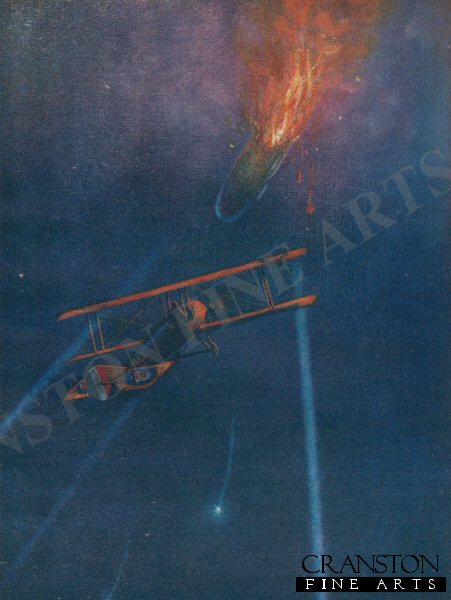
Moonlight Renegade by Stan Stokes. On July 2, 1900 Count Ferdinand von Zeppelin piloted his first rigid-framed, lighter-than-air ship over Lake Constance in Germany. Seventeen years later, on June 16, 1917, Zepellins latest creation, the L-48, was readied at Nordholz, Germany for its first combat mission. The huge L-48 was one of the newest and most technically advanced German airships. Powered by five 250 HP Maybach engines, the great airship could carry 6,000 pounds in bombs, and was manned by a crew of nineteen. For this maiden mission the commodore of the North Sea Airship Division, Victor Schutze, would be joining the L-48s skipper Kapitain-lieutenant Franz George Eichler. Early in the afternoon the L-48 commenced its mission along with several other airships from the Nordholz base. The great Zeppelin would cruise at 60 MPH at 5,000 to 10,000 feet and would ascend to approximately 20,000 feet when approaching its target. This altitude would provide an effective defense against both anti-aircraft or British fighters. RAF Captain Robert Saundby, had returned from the front, to be put in charge of a very small RFC squadron at Oxford Ness. June 16 was a cloudless night, perfect for a Zeppelin attack., and at 11:15 PM Saundby launched his two active aircraft equipped with incendiary machine gun bullets. As he gazed up at the stars at 1:00 AM Saundby was startled to see a huge zeppelin outlined by searchlights only a few miles away. Awakening two of his mechanics, Saundby instructed them to fire up his single-seat DH2 fighter. Although obsolete and not equipped for night fighting, Saundby, who had never flown at night, got the little pusher-propeller fighter in the air, and began a long ascent. After fifteen minutes of flying Saundby spotted the L-48, which was by now attracting anti-aircraft fire which was exploding several thousand feet below the great airships altitude. For an hour or so, Saundby tried to coax every bit of altitude out of his little DH2, but he could not get in range. At around 3:00AM the L-48 completed its bombing runs, and the Captain set a due north course. With dawn only an hour away, Captain Eichler was anxious to get out of British airspace. A report from an observation airship which had accompanied the strike force that evening indicated favorable winds at 13,000 feet. Captain Eichler gave the orders to descend. Meanwhile, Captain Saundby who had fought the cold and wind while tailing the L-48 for nearly three hours, was startled to see the great airship descending. Pushing his DH2 to the limit, Saundby emptied 8 canisters of incendiaries at the L-48. Recognizing the attack the L-48 dumped ballast, and immediately began to ascend. Saundbys last few round met their target and the L-48 erupted. Saundby felt the surge of heat and light, and struggled to keep his little craft under control. Within minutes the L-48s maiden mission was over, as Saundby circled the 750 foot long fireball which had come down at Westford. Amazingly, two of the L-48s crewmembers survived, the only people to ever survive a zeppelin which had been ignited. One of these survivors, Kapitanlieuntenant Meith wrote a letter describing the L-48s fateful misssion, providing much of the historical basis for this incident. |
Magnificent Courage by Stan Stokes. On April 6, 1916 the RFC formed several new squadrons, including the No. 56 Squadron - Scouts. In March of 1917 the unit received the first of its new SE5s. The aircraft was disappointing to the pilots, being slower than expected, and its new Vickers machine gun with interrupter gear was next to useless. Many modifications ensued in the field, and many SE5s were fitted with Lewis guns located atop the upper wing, and in some cases an additional Lewis was installed which could be fired downward through the cockpit. In early April of 1917 No. 56 was ready to see its first combat action, and the unit headed off to France. About nine months earlier the pendulum of air superiority had swung back to the Germans. The Fokker scourge of 1915 had previously been negated by the deployment of DH2 and FE8 aircraft, but the newer German Albatros and Halberstadt fighters had regained the upper hand. The RFC was once again suffering unsustainable casualties. No. 56 Squadron was immediately pressed into service upon its deployment in France, and over the next several months gave a good account of itself. The Squadrons first victory came on April 22, and went to Albert Ball who would become a high scoring ace. On September 23, 1917 many of No. 56 Squadrons pilots would become engaged in what would be considered as one of the epic battles of early aerial warfare. At about 5:00 PM in the evening eleven SE5s took off for a routine patrol. There were heavy clouds at 9,000 feet, effectively limiting the ceiling. Several engagements took place prior to James McCudden noticing a lone SE5 from No. 60 Squadron under attack by a German triplane. Unknown to McCudden was the fact that the triplane was piloted by Werner Voss, a top German ace with 48 confirmed victories. During the next several minutes 7 SE5s focused their efforts on attacking Voss triplane. Voss had several opportunities to make a dash for the German lines, but chose to stay and fight. Demonstrating beautiful flying and determination, Voss held the massed SE5s at bay, and managed to inflict damage on each and every one. With maneuvers made so quickly and so unpredictably, none of the SE5 pilots could keep Voss in their gunsights long enough to fire a meaningful burst. Voss managed to damage two of the SE5s enough that they withdrew from the fight, and a red-nosed German Albatros joined in the fray for a short time. At one point in the battle McCudden indicated that the triplane was in the cone of tracer bullets from at least five machines simultaneously. Voss could out climb and outmaneuver all the RFC craft. Minutes later at about 2,000 feet the SE5 piloted by Arthur Rhys Davids managed to catch the German ace in a straight flat dive, and approached to within feet of the triplanes tail, firing a solid burst before pulling out of his dive. Moments later the triplane hit the ground and disintegrated. Later that evening the pilots of 56 Squadron recounted the epic battle speculating as to who might have been the pilot of the German triplane. The next morning General Trenchard sent an aide to 56 Squdron to elicit details of the battle. In this report James McCudden paid the following tribute to Voss, As long as I live I shall never forget that German pilot who single-handedly fought seven of us for ten minutes, and who put some bullets through all our machines. His flying was wonderful, his courage magnificent, and in my opinion he is the bravest German airman whom it has been my privilege to see fight. |
The First Battle of Britain by Stan Stokes. By the Spring of 1917 the Western Front had been stalemated for more than two years with the armies of Germany and the Allies deadlocked in static trench warfare. At sea, the fleets of both Germany and Great Britain were also at a strategic impasse following the inconclusive Battle of Jutland in 1916. The unrestricted U-Boat campaign in the Atlantic had resulted in Americas entry into the War, and Germany turned to its fledgling air force to help break the deadlock. Night raids by Zeppelins in 1915 and 1916 had proven ineffectual as the great airships had proven vulnerable to the unpredictable weather and to increasingly effective defenses. A new strategic weapon would therefore be utilized - the heavy bomber. With a fleet of such airoplanes, the very heart of London could be attacked. In March of 1917 a new unit was formed in Flanders, soon to be known as the England Geschwader. Lead by Hauptman Ernst Brandenburg, Kaghol 3 (the units official designation,) was equipped with the Gotha G. IV. With a crew of three, and a wingspan of nearly seventy-eight feet, the G. IV was an impressive flying machine. Powered by twin 260-HP Mercedes six cylinder, in-line, water-cooled engines, the Gotha had a top speed of 88-MPH. Its service ceiling was more than 21,000 feet, and its range was 305 miles. The maximum bomb load was 1,100 pounds, but on the first daylight raid on London, each aircraft would carry six 110-lb bombs. For defensive purposes the Gothas were armed with two 7.92mm machine guns. An interesting feature of the G. IV was the ability of the rear gunner to fire not only rearwards and upwards, but could also fire downwards through a specially designed tunnel in the fuselage. On June 13, 1917 Brandenburg led his unit in his red-tailed Gotha on the first daylight bombing raid to London. Twenty G. Ivs departed on this historic mission, but two soon turned back, and another four bombed other targets due to mechanical problems. A total of 128 bombs were dropped on the mission with devastating effects. All told, 162 people were killed in the raid, and another 432 were injured. It was a portent of the future of aerial warfare. Although 94 defensive sorties were flown against the raiders, only a few British fighters made contact with the Gothas before they reached their targets. One fighter which did intercept was a Bristol F2B piloted by Capt. C. W. E. Cole-Hamilton of No. 35 Training Sqaudron. The observer, Capt. C. H. Keevil was killed during the battle. After the safe return of all the Gothas, Brandenburg was personally decorated with the Pour le Merite. Unfortunately, he was seriously injured in a flying accident only six days later. By then the first battle of Britain was well underway. |
Tribute to Julius Buckler by Ivan Berryman. Having been wounded early in World War One as a soldier on the Western Front, Julius Buckler had become a pilot with Jasta 17 by November 1916. He scored his first victory that December, one of almost 30 enemy aircraft. Frequently out of action due to wounds including simultaneous broken arms, he is seen here flying his Albatros D.III names Mops, the aircraft he used to claim his first balloon victory on 26th April 1917. He went on to score 7 balloon victories and was awarded the Blue Max. He died in 1960 aged 66. |
Leutnant Josef Jacobs by Ivan Berryman. Germays greatest exponent of the Fokker Dr1 Triplane, Leutnant Josef Jacobs is depicted chatting with colleagues of Jasta 7 before a sortie in the spring of 1918. His black Triplane became well known to allied pilots, not least because of his formidable kill rate. By the end of the war, still aged just 24, Jacobs had claimed 48 enemy aircraft destroyed. The unusual practice of applying the black cross to the upper sides of the lower wings was to counter friendly fire from other German aircraft who frequently mistook the Dr1 for a Sopwith Triplane. |
Zeppelin Gunners by Ivan Berryman. Droning over the coast en route to another night attack on mainland Britain, the Zeppelins top gun platform goes into action as BE.2 fighters wheel around the gas-filled giants, trying desperately to fire their Brock, Pomeroy and Sparklet ammunition into the volatile gasbags that lay beneath the Zeppelins skin. Often freezing cold, always vulnerable, the defensive gunners occupied a tiny, sunken recess on the very top of the airship, shielded from the buffeting winds only by a shallow screen and their thick leather flying suits. Just a handrail and a shallow step lay between them and a vertiginous drop over the rolling sides of their massive craft. Their air-cooled Parabellum MG.14 machine guns did little to repulse their attackers, whilst the great Zeppelins offered themselves as huge, bloated targets for ground artillery as well as the brave pilots of the RFC. |
Tribute to Friedrich Noltenius by Ivan Berryman. Studying medicine at the outbreak of World War One, Friedrich Noltenius was a decorated artillery soldier by the time he started flying missions in mid-1918. Flying with Jasta 27, he scored 13 victories before transferring to Jasta 6 in September 1918. A noted balloon buster, he is shown here in his personalised Fokker D.VII of Jasta 6 during October 1918. Scoring a total of 21 victories by the end of the war, his 20th entitled him to the award of the Blue Max to add to his Württemberg Knight's Cross, but the end of the war prevented him from receiving it. After the war he returned to medicine and became a doctor, but was killed in a flying accident in 1936. |
Showtime at the Circus by Stan Stokes. Born in Prussia to wealthy aristocratic parents, Manfred F. von Richtofen, The Red Baron, was to become the top ace of World War I, with 80 confirmed kills, and probably another 40-50 which took place over enemy lines and could not be confirmed. Richtofen was originally a cavalry officer, but with great persistence he was transferred to the air arm. After a brief period on the eastern front Richtofen was transferred to the western front in August 1915. His first confirmed victory was recorded in September 1916 and by November he recorded eleven kills, including Major L. Hawker, the top British fighter pilot at that point in time. With his keen reflexes and eyesight he quickly ascended, and by June 1917 Richtofen took control of a unit near Coutrai. This unit became known as Richtofens Circus. By July the ringmaster had his fifty-seventh victim. Despite his successes Richtofen shunned publicity and became increasingly withdrawn. Richtofen was wounded in combat and spent three weeks in the hospital recuperating. After his return to duty Manfred became a vocal proponent of the Fokker triplane. The bright red paint scheme utilized on one of Richtofens aircraft is what earned him the nickname, The Red Baron. Richtofens brother, Lothar, was also an ace with forty victories to his credit. By April of 1918, aided by Americas entry into the War, Germany was facing overwhelming numbers of enemy aircraft, and many with performance capabilities the equal to, and in some cases superior to, their own. The Germans mounted a final desperate offensive, and on April 21,1918 The Red Baron finally fell victim to the perils of combat. Although there is considerable controversy over the Red Barons demise, it appears that Richtofen was either killed by Captain Arthur Brown, a Canadian flying with the RAF, or was shot down by Australian machine gunners while evading Captain Brown. Richtofen was provided a full military funeral by the Allies, and on the evening following his funeral a single RAF fighter dropped a small package containing photos of the funeral onto the Circus headquarters. By Wars end the Circus was credited with the destruction of 644 aircraft, but 56 of its airmen had been killed, 32 seriously wounded, and 6 captured. |
Early Night Raiders by Stan Stokes. One of the strategies utilized by the German military in WW I was the terror bombing of civilian targets in hopes of swaying popular opinion to permit favorable peace terms to be exacted. While this strategy was flawed, the principal instrument utilized in its implementation early in the War was the dirigible. While dirigibles had the range to hit targets in Britain, they became increasingly vulnerable to attack as fighter aircraft and ammunitions performance improved. One of the most successful developers and builders of these dirigibles was Count von Zeppelin. Zeppelin was a visionary in airship and aircraft design, and by the time WW I had begun his interest had largely shifted from lighter-than-air airships to more conventional aircraft designs. Zeppelin was well aware that his giant dirigibles had severe limitations in a military role, including their large size, slow speed, small payload capacity, and most important their high flammability. What was needed was a conventional aircraft capable of flying round-trip to strategic military targets that could carry a meaningful payload. Such aircraft would have to be fast enough and have sufficient defensive armament to evade or fend off enemy pursuit aircraft to complete their missions. The most impressive and successful aircraft in this class were built by the Zeppelin-Werke Staaken, a company formed by Zeppelin in Berlin with Robert Bosch as his partner. The company's first goal was to develop a long-range, six-engine, bomber/transport. By late 1915 German military authorities recognized the need for such aircraft and laid down specifications for their design. Included in the specs were the unique requirements for oxygen apparatus, in-flight servicing of the engines, and for both onboard navigational and communications apparatus. Called R-planes by the military, Zeppelin produced a series of three giants, commonly all referred to as Zeppelin-Staakens. Only one of the R-planes was actually downed by opposing fighters. The R.43 was downed while flying a night bombing mission on August 10, 1918 near Abbeville, England. The R. V series was the largest of the series, but only one aircraft was produced. With a wingspan in excess of 138 feet, it was powered by five 245-HP Maybach engines. Its gross weight at takeoff of more than 28,000 pounds was 15 to 20 times that of a typical fighter aircraft. Despite its size the wing loading of the Zeppelin-Staakens compared favorably to most fighter aircraft of the era. Shown in Stan Stokes' painting is a Zeppelin-Staaken R. VI, the blunt-nosed, 4-engine, version of the German giants. This was the most widely built version of the Zeppelin-Staaken series. Preparing for a night bombing mission at dusk, the crew readies the massive aircraft for a long flight to a target in Britain. |
Boom Boom Billy by Stan Stokes. William Avery Bishop, the top scoring RFC ace of WW I, was born in Ontario Canada on February 8, 1894. He entered the Royal Military College in 1911 and after War broke out in Europe he was assigned to the 14th Battalion of the Canadian Mounted Rifles. Bishop applied for a transfer to the Royal Flying Corps in 1915. Following a few months of training he was made an observer and was sent to France to fly with No. 21 squadron. He was hospitalized for frostbite and later from injuries sustained in a bad landing. In late 1916 he began pilot training and in March of 1917 Bishop was posted to No. 60 squadron flying Nieuport Scouts. On March 25 he experienced his first air combat, downing an Albatros single-seater. Bishop scored thirteen victories during Bloody April, and another seven-and-a-half in May. He was awarded the DSO at this point. In early June Bishop attacked a German airfield at dawn, and shot down three Albatros aircraft taking off to challenge him. For this fete he received the Victoria Cross. In constant combat during the summer months, Bishops score rose to 45 by mid-August. He was the first to exceed the record of the famous British Ace, Albert Ball. During this period Bishop often flew as many as seven-eight hours each day. He was aggressive in the air and obviously possessed excellent flying instincts and marksmanship skills. Eleven of these 45 victories were achieved in the SE-5 with which No. 60 squadron had been re-equipped. Promoted to Major, Bishop returned to Canada for a recruiting tour. In 1918 he returned to England, first as the Chief Instructor at Aerial Gunnery School, and later as the Commander of No. 85 squadron. Once again Bishop was at his best in the air. Flying SE-5s, Bishop claimed 27 more victories during this final combat tour, including four Pfalz D.IIIs. Bishop received the DFC, and returned to the Air Ministry in England for a short time before returning to Canada in August of 1918. There he played an important role in the formation of the new Canadian Air Force. Bishops official victory total of 72, the highest for any RFC flyer in WW I, approached the official total of von Richtofen who had 80. Some historians have disputed Bishops score, indicating that he received credit for a number of victories when he was flying alone. Following the War, Bishop formed a commercial aviation company with another ace W.G. Barker. He later served with the RCAF during WW II as an Air Marshal responsible for training. Billy Bishop passed away in 1956 at the age of seventy. In Stan Stokes nostalgic painting the top RFC ace is depicted early in his career flying his Nieuport against a German Albatros. |
Donald MacLaren by Ivan Berryman. The highest scoring Sopwith Camel ace of World War 1, Donald MacLaren was born in Ottawa, Canada, in 1893. Joining the Royal Flying Corps in 1917 as a trainee pilot, it was only the following March that he claimed his first victory, a Hannover C-Type whilst posted to 46 Squadron. His kill rate was quite formidable for, in this the final year of the war, he was to claim no fewer than 54 confirmed victories. Indeed, in the period from 15th September to 2nd October, he claimed eight Fokker D.VIIs - a remarkable feat against Germanys most potent fighter. He is pictured here attacking a D.VII in Camel F2137 U of 46 Sqn. MacLaren survived the war and died in 1989. |
Jasta 10, Northern France Early September 1917 by David Pentland. The Jasta was part of the Flying Circus, and one of the first units to receive and be fully equipped with the new Pfaltz DIII aircraft. In their capable hands this elegant aircraft proved an effective weapon. |
Behind the Lines, France 1918 by David Pentland. Fokker DVII of Royal Bavarian Jagdstaffel 35b, flown by Leutnant Rudolf Stark, the new Jasta Commander. |
Lieutenant W L Robinson Attacks an Enemy Airship and Brings it Down in Flames by W Avis (P) On the night of September 2nd-3rd 1916. Lieutenant William Leefe Robinson, of the Worcester Regiment and Royal Flying Corps, attacked an enemy airship under circumstances of great difficulty and danger, and sent it crashing to the ground as a flaming wreck at Cuffley, near Enfield. He had been in the air for more than two hours, and had previously attacked another airship during his flight. For this act of most conspicuous bravery he was deservedly rewarded with the VC. |
Ltn Fritz Kempf by Ivan Berryman. The Fokker DR.1 Triplane (213/17) of Fritz Kempf swoops on a pair of unsuspecting Sopwith Camels whilst on patrol over the Western Front in 1917. Kempfs practise of having his name painted across the top wing of his aircraft was supplemented by the taunt Do You Remember Me? on the mid wing. His aircraft is depicted in the colours worn by Jasta Boelcke of the Imperial Air Service. |
Gefreiter Jakob Tischner - Roland D.VIa by Ivan Berryman. The LFG Roland D.VI did not enjoy the success of its contemporaries, the Fokker D.VII and Pfalz D.XII, but was nonetheless a potent and capable fighter. Its unique Klinkerrumpf fuselage construction made it both lightweight and robust although, despite its qualities, it was not built in large numbers. This particular example, a D.VIa, is shown chasing down a damaged Sopwith Camel whilst being flown by Gefreiter Jakob Tischner of Jasta 35b. Tischner later wrote off this aircraft in a landing accident when he rolled into a parked Pfalz D.III, destroying both machines. |
Oberleutnant Godwin Brumowski by Ivan Berryman. Albatros DIII of Godwin Brumowski about to shoot down a Caquot balloon. |
Albert Ball by Ivan Berryman. Albert Ball in his Nieuport 17 having just shot down a German LVG. His aircraft, A134, was distinctive in having a bright red spinner. He was the first Royal Flying Corps pilot to score a hat-trick (3 kills on a single mission) and, in the course of his career, scored another two on his way to his outstanding 44 victories. |
Tribute to Erich Lowenhardt by Ivan Berryman. Erich Lowenhardt was one of the most famous German Aces of World War One. A rival of the likes of Ernst Udet and Lothar von Richthofen in number of victories, he racked up an impressive 54 victories before his death in August 1918, caused by a failed parachute when he bailed out after a collision. He is depicted here, not in his final Fokker D.VII, but in an Albatros D.III, claiming one of his tally of 9 observation balloons - this one in May 1918. The fortunate balloon observer has managed to take to his parachute to escape this time, a measure the observers were often forced to employ by the German balloon busters. |
Leutnant Hans von Keudell by Ivan Berryman. An early star of Jasta 1, von Keudell is depicted here in his Halberstadt D.III, (instantly identifiable by his initial K on the fuselage side) as he drifts into position to exploit the blindspot of a Vickers Gunbus, late in the day in 1916. Von Keudells closing tally was 11 confirmed victories, but a possible 12. |
Hansa Brandenburg W.12 - Attack on the C.17 by Ivan Berryman. On the morning of 21st April 1917, coastal airship No C.17 was on a routine patrol captained by Sub Lieutenant E G O Jackson, when sometime around 8.00am, she was attacked by German seaplanes and shot down. Such was their vulnerability that these huge battlebags were an easy target for marauding enemy scouts, their single Lewis guns achieving little by way of defence. The Hansa Brandenburg W.12, on the other hand, was a nimble and useful aircraft that the Germans put to good use in the coastal defence role. |
|
Contact Details |
|
Sign Up To Our Newsletter!
This website is owned by Cranston Fine Arts. Torwood House, Torwoodhill Road, Rhu, Helensburgh, Scotland, G848LE Contact: Tel: (+44) (0) 1436 820269. Email: cranstonorders -at- outlook.com
|
 |