|
|
|
|
|
|
|
|
|
WW1 Art - Jason Askew
First World War Art  Artists Artists  Jason Askew Jason Askew |
[UP] - Ivan Berryman - Jason Askew - Chris Collingwood - David Pentland - Anthony Saunders - Stan Stokes - Charles Dixon - Richard Caton Woodville - William Barnes Wollen |
Jason Askew was born in Johannesburg, South Africa in 1966. He attended the Johannesburg School of Art, Ballet and Music receiving a first class grounding in Art and Graphics. After gaining experience working for "The Unit" advertising agency in Johannesburg, he spent time in the world of advertising, working with Art Directors on various commercials and television productions in South Africa.
He then became a senior Graphic Artists at "The Star" newspaper, Johannesburg, where he became well known for his graphic impressions of newsworthy items including the appearance of Winnie Mandela at the Truth and Reconciliation Committee, graphics of Nelson Mandela and Louis Luyt at the "SARFU" trial in Pretoria. Jason also worked as a court artist but is presently devoting himself full time to paintings and sculpture. Jason has painted numerous commissions and has held many exhibitions in South Africa and now the UK. Jason is currently working on the next six paintings in the Anglo-Zulu war series. these prints are now available direct from Cranston Fine Arts, the military art company.
|
|
|
|
|
|
|
|
|
|
|
|
|
| Text for the above items : |
Passchendaele by Jason Askew. The German attack on the British trenches at Passchendaele in the rain. |
The Battle of the Somme - At the German Trenches by Jason Askew. Very few of the British soldiers made it through the barbed wire defences, and even fewer to the German trenches. By the end of the first day the British losses were 60,000 men. |
2nd Australian Brigade fighting in Gully Ravine by Jason Askew. The 2nd Australian Brigade were brought up to reinforce the British attempt to force the Turkish positions at Achi-baba. This action developed into the second Battle of Krithia. |
The Ludendorff Offensive, Spring 1918 by Jason Askew. (GL) No text for this item |
Over the Top by Jason Askew. The 29th Division go over the top to the sound of the officers whistle to attack Beaumont Hamel during the battle of the Somme. The regiments of the 29th Division are the Middlesex Regiment, Lancashire Fusiliers, Dublin Fusiliers, Royal Fusiliers and the Newfoundland Regiment. |
German Assault on the Nimy Bridge, Mons, 23rd August 1914 by Jason Askew. German forces begin their assault on the Nimy Bridge, 23rd August 1914. The bridge was defended by the 4th Battalion The Royal Fusiliers. |
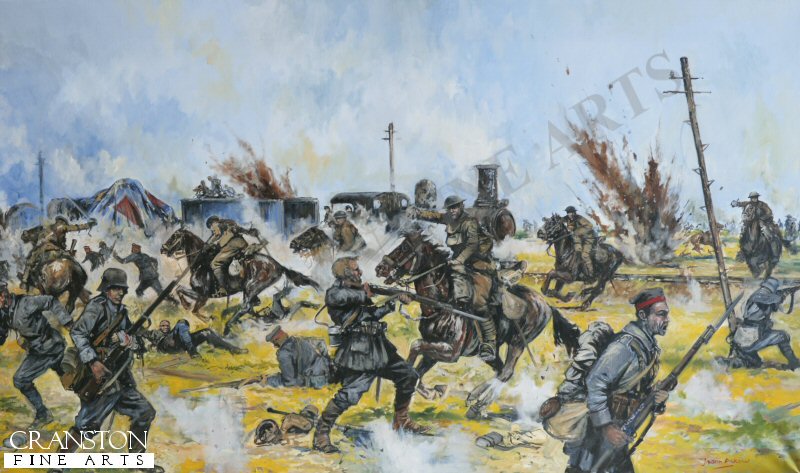
Inniskilling Dragoons at Amiens by Jason Askew. (GL) The Inniskilling Dragoons capturing a German railway gun at Harbonnieres during the battle of Amiens, 1918. |
Cameron Highlanders Capture a German Force on the Yser by Jason Askew. This incident took place on October 23rd,1914. A party of German soldiers had been driven to take shelter in the small house. British artillery then targeted the house, making the situation of the Germans uncomfortable. Under cover of the bombardment, a company of Cameron Highlanders rushed the position, intercepting the Germans as they tried to extricate themselves. After a brief struggle, and being somewhat unnerved by the prompt appearance of the Highlanders; the German group surrendered. |
Advance into Hell by Jason Askew. The Middlesex Regiment advance across No Mans Land during the Battle of the Somme. |
The Great Folly of 1916 by Jason Askew. Assault in the vicinity of Thiepval by the Ulster division-1st July 1916. The 11th Royal Irish Rifles, moving forward from the A line of trenches, and moving forward to attack the B line of trenches, the attacking infantry are preceded by Bombers - seen carryng grenades in green canvas buckets - who are engaged in throwing grenades in anticipation of the rifle company assault on the enemy trenches; an activity barely changed since the days of Marlborough. The rifle companies are armed with the Lee Enfield SMLE - a superb rifle, though expensive to make. The advance is made with bayonets fixed, as trench clearing involved numerous hand to hand confrontations and bayonet fights. The rifle companies are supported by two Lewis gun teams per company. Note that visible in the painting is a man carrying an orange painted steel marker, painted on one side only. The markers are to to indicate to British artillery observers as to the most forward positions taken by the British advance. Naturally, one does not present the orange side to the enemy! |
Faster Boys - Give Them Hell! Loos, September 25th 1915 by Jason Askew. Dawn. British artillery thundered, and the territorial soldiers 15th Scottish division stormed towards the German trenches defending the coal mining village of Loos. The gas cloud that preceded the Highland advance was pendulous and largely stationary due to a distinct lack of wind, and ,upon emerging from the smudgy gas, the highlanders were pelted with machine gun fire and shrapnel from the defending German batteries. Not to be denied, the Scots gritted their teeth, and with an officer shouting faster boys! give them hell! the highlanders charged straight at the defenses. The Germans, unnerved by the stubborn courage of their kilted opponents, began to fall back through the village of Loos. The Camerons and the Black Watch, shouting their battle cry and charging down the main road of the village, then engaged the defending Germans in a series of savage battles for each and every house - hob-nailed boots, rifle butts, and bayonets being wielded with great enthusiasm by the vengeful Scots. By 8.00am the village was in Scottish hands. |
Remember that you are Scottish! Aubers Ridge, 9th May 1915 by Jason Askew. Aubers / Neuve Chapelle -1500- The 1st battalion, Black Watch, brought in to relieve the shattered 2nd Brigade, go over the top and advanced at the double across no -mans land. Suffering heavy casualties from the incessant German machine gun fire, elements of the regiment plunged into the German trenches just as the bombardment lifted. A desperate battle then took place for the German position, the outnumbered Highlanders fighting tenaciously; elements of the regiment even reached the German second line. In spite of their superhuman bravery, and being reinforced by two companies of the Camerons, sheer German numbers proved to be overwhelming for the Black Watch; every single highlander being killed or wounded in defending this hard won position. |
Gallipoli - Courtneys Trench by Jason Askew. Australian VC winner-Private Albert Jacka, 14th battalion. He killed nine Turks who had bombed and infiltrated an Australian trench at Courtneys post during the great Turkish assault on 19th May. |
|
Contact Details |
|
Sign Up To Our Newsletter!
This website is owned by Cranston Fine Arts. Torwood House, Torwoodhill Road, Rhu, Helensburgh, Scotland, G848LE Contact: Tel: (+44) (0) 1436 820269. Email: cranstonorders -at- outlook.com
|
 |