|
|
|
|
|
|
|
|
|
World War One Naval Art
First World War Art  Naval Art Naval Art |
|
Naval art prints of World War One of Battleships, Cruisers, Destroyers and Submarine art by naval artists Randall Wilson, Anthony Saunders, and Ivan Berryman, published by Cranston Fine Arts.
|
| Navigation | |
| Page 3 of 8 | Previous .. Page 3 .. Next |
|
|
|
|
|
|
|
|
|
|
|
|
|
|
|
|
|
|
|
|
|
| Navigation | |
| Page 3 of 8 | Previous .. Page 3 .. Next |
| Text for the above items : |
Revenge and Lion by W L Wyllie. The British Royal Navy battleship HMS Revenge (under the command of Captain E B Kiddle, and served in the1st Battle Squadron), and the battlecruiser HMS Lion (served as Vice Admirals Beattys Flagship at the battles of Dogger Bank and Jutland) lay at anchor during the First Wolrd War. |
HMS Barham leads the 5th Battle Squadon at Jutland by Anthony Saunders. The greatest naval battle of the First World War took place on the 31st of May and the 1st of June 1916, near the Danish province of Jutland. It was the first and only sea battle between the British and German fleets, and certainly proved to be the clash of the Titans that the First Lord of the Admiralty, Winston Churchill, had long planned. Decisive victory was claimed by both sides, but, desperately fought though it was, the outcome was indecisive. The Royal Navy suffered higher losses in both men and ships, but the German fleet never ventured out of harbour to seek battle again. During the daylight fighting HMS Barham, under Rear Admiral Evan-Thomas, lead the 5th Battle Squadron (Valiant, Warspite and Malaya) and is seen here at 4.50pm exchanging with Hippers battle-cruisers to the south. |
HMS Pegasus by Ivan Berryman. The last seaplane carrier built for the Admiralty, HMS Pegasus was launched in 1917 and benefited from all the lessons learned from her predecessors, possessing a flying-off platform forward, served by twin derricks, and a hangar and cranes aft, capable of carrying up to nine aircraft. She is shown here with one of her Short 184s (N9290) about to take off, whilst a similar aircraft is preparing to be lowered into the water in the background. |
The Last of Scharnhorst and Gneisenau by W L Wyllie. During the battle of the Falkland Islands, both the German ships Scharnhorst and Gneisenau were sunk after battling with the Royal Navy battleships HMS Invincible and HMS Inflexible and heavy cruiser HMS Carnarvon. |
Scapa Flow Graveyard by Robert Barbour. HM submarine H.28 enters Scapa Flow anchorage, passing the forlorn Battle Cruiser SMS Derfflinger and a group of sunken destroyers H.28 was one of the H class submarines. Launched in March 1918, she was finally scrapped in 1944. |
The Second Division at Jutland by W L Wyllie. View from HMS Orion looking back on first HMS Monarch, then HMS Conqueror, HMS Thunderer and HMS Iron Duke. |
The Kaiser's Ship by Randall Wilson. Emerging from a smokescreen SMS Baden surges ahead of her sister ship SMS Bayern to resume battle speed in these fleet manoeuvres in the Baltic, during 1917 |
Engage by Randall Wilson. HMS Glorious and HMS Repulse fire opening salvos against the German cruiser Pillau at the Heligoland Bight 17th November 1917. |
Battleships in the Forth by W L Wyllie. Two copies available |
HMS Lion at the Battle of Jutland by Ivan Berryman. HMS Lion with her sister ship HMS Princess Royal are shown firing on the German High Seas Fleet which can be seen in the distance during the Battle of Jutland. |
HMS Agincourt by Randall Wilson. HMS Agincourt is shown alongside HMS Erin with ships of the 1st Battle squadron of the Grand Fleet, on the eve of the Battle of Jutland. |
Transferring the Dead, Wounded and Prisoners by W L Wyllie. Two copies available |
Defence and Warrior in Action by W L Wyllie. No text for this item |
Nurnberg Sinking by W L Wyllie. At the end of the Battle of the Falkland Islands, while boats from HMS Kent went to pick up survivors of the Nurnberg, the German cruiser hauled right over on her side and sank. The remaining crew were a brave lot - one man stood aloft and held the German ensign waving in his hands til the ship went under. |
The Battle of Jutland, HMS Royal Oak by Anthony Saunders The British Grand Fleet had been virtually unopposed for nearly a century but now there was a challenge to the throne: the German Navy. Although smaller, it had caught up fast and by the time of Jutland, had some telling advantages over the British Fleet. the plan for the battle was to lure the British Grand Fleet into a lethal trap in German waters. In the event although desperately fought by both sides, the battle was a stale mate. the confused conflict was hampered on both sides by bad luck, bad weather and poor communications. at the end of the battle, the Royal navy had suffered higher losses in men and ships, but the German fleet never ventured out of harbour to seek battle again. |
HMS Benbow at the Battle of Jutland by Anthony Saunders. HMS Benbow was completed in 1914, built by Beardmore (launched 12th November 1913). On the 10th of December she joined the Grand Fleet serving with the 4th Battle squadron. She was the flagship to Admiral Douglas Gamble until he was replaced in February 1915 by Sir Doveton Sturdee. During the Battle of Jutland. she suffered no damage. After the war she served from 1919 in the Mediterranean providing Gun fire support to the white Russians in the Black Sea until 1920. She remained in the Mediterranean until 1926 joining the Atlantic fleet for the next three years until 1929 when she was paid off and scrapped in March 1931. |
Fast and Furious by Stan Stokes. Thomas Sopwith was a distinguished British aviator who organized the Sopwith Aviation Company. Sopwith produced an aircraft which won the coveted Schneider Trophy race. With the start of WW I, Sopwith Aviation shifted its focus to military aircraft, and was to become one the major suppliers to both the Royal Air Corps and the Royal Naval Air Service. In October of 1914 two Sopwith Tabloids flew a 200-mile round trip strike against the airship sheds at Dusseldorf and Cologne. The Sopwith Strutter firmly entrenched Sopwith as a producer of quality-built aircraft. The Strutter was a precursor of the Sopwith Pup, which would serve as the Royal Navys first carrier aircraft. The first production Pup was delivered to the Royal Navy in 1916. Most Pups were powered by a 80-HP Le Rhone radial engine, which gave the Pup a top speed of 115-MPH and an endurance of three hours. Many Navy Pups were modified to utilize a tripod mounted Lewis gun which could be fired forward or upwards through a cutout in the upper wing. Sopwith Pups were also utilized on battlecruisers. In fact, a Pup launched from the HMS Yarmouth downed the Zeppelin L.23 in August of 1917. The Royal Navys HMS Furious was the first dedicated aircraft carrier in the world. The Furious was initially laid down as a battlecruiser, but the design was modified during construction to include a flying deck forward of the main bridge. This configuration allowed aircraft to be launched as the Furious steamed into the wind. An attempt at recovery by having aircraft side slip on to the deck proved ineffective with one of the early attempts resulting in the death of the pilot, Squadron Commander E. H. Dunning, who had made the worlds first successful carrier landing on a ship underway only days earllier. The Royal Navy decided to further modify the Furious by adding a second deck aft of the bridge. The fore and aft decks were connected by a narrow ramp on either side of the funnel and bridge, and this permitted aircraft to be to moved between the two decks. Sets of longitudinal wires were set across the aft deck, and were designed to catch the skids of the Sopwith Pups during landings. Recovering aircraft was still tricky, and a rope barrier was erected aft of the mainmast to prevent aircraft which overshot from crashing into the superstructure of the ship. The first carrier-based naval air strike in history was carried out against the Zeppelin hangars at Tondern by the Furious on July 19, 1918. Seven Sopwith Camels, each carrying two 50-pound bombs were utilized for this mission. This important moment in the history of naval aviation is captured magnificently in Stan Stokes highly detailed painting entitled Fast and Furious. |
HMS K17 by Ivan Berryman. K17 was one of the unusual K-class submarines operating in the Royal Navy in World War One. This class were unusual in that they were powered by steam while operating on the surface to allow them the speed to keep up with the fleet. They were also unusual in their notorious poor fortune, gaining the nickname 'Kalamity Class'. None of the class ever successfully engaged with the enemy, and yet 6 were lost in accidents, including K17. Known as the 'Battle of May Island', a series of unfortunate collisions between submarines and surface vessels in the misty darkness of 31st January - 1st February 1918 saw both submarines K4 and K17 sunk, with several other vessels damaged. From a crew of 56, just 9 men escaped from K17 and just 8 survived the freezing waters. Here, K17 is shown cruising on the surface with funnels up in 1917. |
SMS Derfflinger By Randall Wilson. SMS Derfflinger at anchor at Kiel, 1918. Astern is SMS Hindenburg. |
Scharnhorst at Anchor by Robert Taylor. No text for this item |
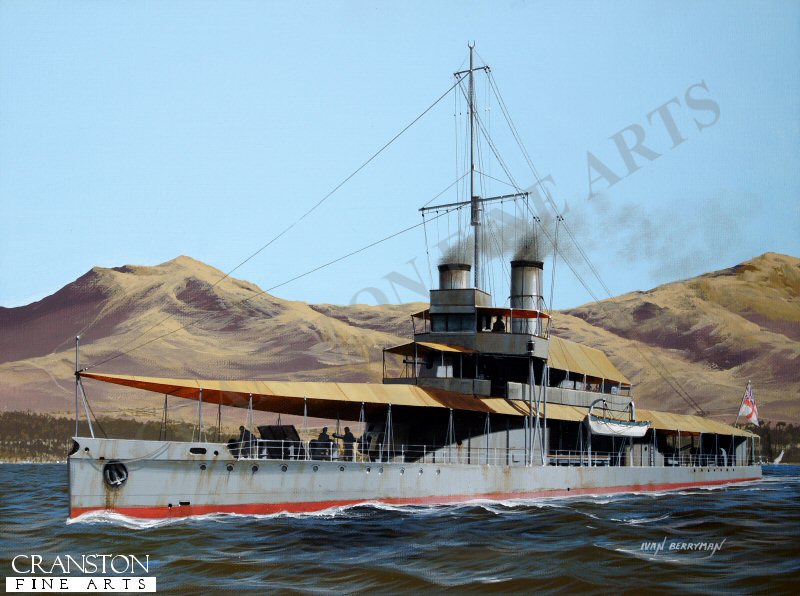
HMS Mantis by Ivan Berryman. An Insect class river gunboat, HMS Mantis took part in operations on the River Tigris in modern-day Iraq in World War One. A British Army advance up the Tigris in 1915 took the town of Kut-al-Amara, but this army of more than 10,000 men were besieged by the Turks here, eventually surrendering in April 1916. With other river gunboats, HMS Mantis had attempted to help break the siege from early March 1916, and remained on the River Tigris until again called upon to assist an expedition in early 1917. As part of a fleet of nearly 20 river gunboats, HMS Mantis helped the forces of Sir Stanley Maude recapture Kut-al-Amara on 24th February 1917. The ship had a long career, briefly serving in north Russia during their civil war in 1919 before serving in China during the 1920s. Still operational at the beginning of World War Two, HMS Mantis was eventually scrapped in 1940. |
|
Contact Details |
|
Sign Up To Our Newsletter!
This website is owned by Cranston Fine Arts. Torwood House, Torwoodhill Road, Rhu, Helensburgh, Scotland, G848LE Contact: Tel: (+44) (0) 1436 820269. Email: cranstonorders -at- outlook.com
|
 |