|
|
|
|
|
|
|
|
|
Aviation Print List - World War One
First World War Art  Aviation Art Aviation Art  WW1 Aviation Print List WW1 Aviation Print List |
[UP] - British Aviation - German Aviation - US Aviation - French Aviation - Ilya Muromets - Hanriot HD.1 - Caproni Ca.3 - Fighter Aces - WW1 Aviation Print List |
|
Listing of WW1 Aviation Prints |
| Navigation | |
| Page 1 of 13 | Page 1 .. Next |
|
|
|
|
|
|
|
|
|
|
|
|
|
|
|
|
|
|
|
|
|
| Navigation | |
| Page 1 of 13 | Page 1 .. Next |
| Text for the above items : |
Richthofens Flying Circus by Nicolas Trudgian. Nicolas Trudgians dramatic painting recreates a scene near Cambrai, Northern France on the morning of March 18, 1918. Aware of a build-up of forces for a massive German offensive, many RFC squadrons attacked the German positions at very low altitude. Responding with as many squadrons as they could muster, including Richthofens JG1 wing, there followed one of the largest dog-fights of the entire First World War. Seen in the foreground are a Fokker Triplane and an Albatros, having winged a Sopwith Camel from 54 Squadron, as another Camel, and a Bristol fighter of 11 Squadron RFC turn to engage the German fighters. |
Edward Rickenbacker by Ivan Berryman. Captain Edward Rickenbacker of the 94th Sqn, United States Air Force, is shown in his Spad S.XIII, pursuing a Fokker D.VII. Eddie scored his first victory on 29th April 1918, but by the November Armistice he had increased his tally to 26 confirmed kills. |
Aviatik B.1 by Ivan Berryman. Based upon the design of an earlier 1913 racing biplane, Aviatik AG were able to introduce their B.1 into military service almost at the outbreak of World War 1, the type proving to be a useful reconnaissance machine during the early stages of the conflict. As with most B type aircraft of this time, the Aviatik B.1 was unarmed and carried an observer in the forward cockpit. Power was provided by a Mercedes D.1 inline engine whose large radiators were fitted to the port side of the fuselage, just above the lower wing. There is no record of exactly how many B.1s were constructed. |
A Pair of Aces by Ivan Berryman. With dozens of confirmed victories at the end of WW1, the great Austro-Hungarian ace, Godwin von Brumowski was a formidable opponent, his red Oeffag-built Albatros D.III 153.45 of Flik 41J notorious in the skies above the Piave River on the Italian Front. When flying with his fellow ace, friend and wingman, Frank Linke-Crawford, they formed a deadly partnership, the two of them frequently sharing victories as they tore through their enemies' air forces, downing fighters, bombers and balloons alike. Brumowski's confirmed total at the war's end was 35, with many more 'probables', whilst Linke-Crawford was to claim a total of 27. They are depicted here in their distinctive aircraft, carrying out a low-level patrol late in the afternoon in the Dolomites in December 1917, just weeks before Linke-Crawford left the squadron to take up his appointment as Commanding Officer of Flik 60. It is popularly believed that the falcons painted on the sides of his aircraft led to Linke-Crawford later acquiring the title 'The Falcone of Feltre'. |
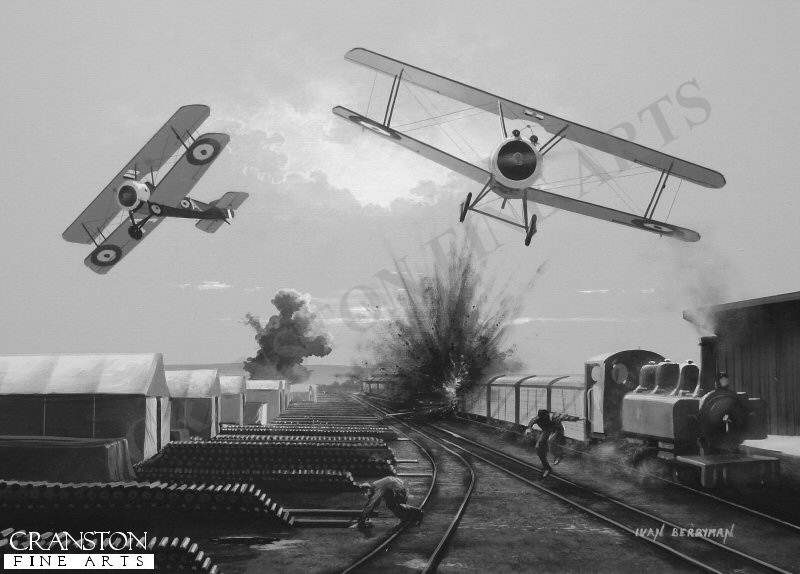
Mayhem at Vieille Chapel by Ivan Berryman. (PC) No text for this item |
A Hand of Aces by Ivan Berryman. Sopwith Camels of 45 Sqn, Istrana, are shown on an early patrol on a crisp morning in the Winter of 1917-18. B6238 was an aircraft shared by Lts E McN Hand and H M Moody, whilst B6354 was the mount of Lt J C B Firth. |
Leutnant Hans von Keudell by Ivan Berryman. An early star of Jasta 1, von Keudell is depicted here in his Halberstadt D.III, (instantly identifiable by his initial K on the fuselage side) as he drifts into position to exploit the blindspot of a Vickers Gunbus, late in the day in 1916. Von Keudells closing tally was 11 confirmed victories, but a possible 12. |
The Tenacious Grid Caldwell by Ivan Berryman. New Zealand's highest scoring ace, with 25 victories to his credit, proved himself to be an extraordinary and resourceful leader. Whilst on a routine patrol in September 1918, Keith Logan 'Grid' Caldwell's 74 Sqn SE5a was involved in a mid-air collision with another SE5a, the impact breaking one of Caldwell's struts and destroying the aerodynamics of his aircraft, which promptly dropped 1,000 ft and went into a flat spin. Incredibly, Caldwell climbed from the cockpit of his stricken machine and held the broken strut together with his left hand whilst keeping his right hand on the joystick, somehow steering his wayward fighter out of danger and over friendly territory. With no hope of a safe landing, the Kiwi jumped clear of the SE5a just a second or so before it impacted with the ground. Astounded British soldiers in a nearby trench saw Caldwell stand, dust himself off and walk casually toward them. He returned to his unit and continued flying until the end of the war. |
The Final Curtain by Ivan Berryman. On the 20th of April 1918, just one day before his death, the legendary Red Baron, Mannfred von Richthofen, claimed his final victory. His famous Flying Circus was engaged in battle by Sopwith Camels of No.3 and No.201 Squadron. Claiming his 79th victory, he had shot down Major Richard Raymond-Barker earlier in the dogfight - the British pilot being killed in the resulting crash. However, it is his 80th and final victory that is depicted here. In the centre of the painting, the Sopwith Camel of David Lewis has been brought into the firing line of von Richthofen, and is about to be sent down in flames from the sky - Lewis was fortunate to survive the encounter relatively unscathed. Meanwhile the chaos of the dogfight is all around this duel, with aircraft of both sides wheeling and diving in combat. The other pilots depicted are Weiss, Bell, Riley, Steinhauser, Mohnicke, Hamilton and Wenzl. |
Sous-Lieutenant Willy Coppens - Roasting A Sausage by Ivan Berryman. During an amazing spree of balloon-busting during 1918, Willy Coppens gained notoriety over the Western Front for his sheer daring and marksmanship, sending no fewer than 35 observation balloons plummeting to the ground, as well as two aircraft. Here, Coppens despatches a Drachen balloon flying his modified Hanriot HD.1 No23 which he had painted blue because he so disliked the ugly, bad camouflage in which it was delivered. Despite losing a leg whilst downing his final two balloons, Coppens survived the war and lived a full life until his death in December 1986. |
Tribute to Giovanni Ancillotto by Ivan Berryman. Italian Ace Giovanni Ancillotto scored a total of eleven victories during the Great War. This total includes two pioneering night-fighter victories in the summer of 1918. He is best known for his third balloon-busting victory in late 1917, however, during which his Nieuport 11 was severely damaged as he pressed home his attack with rockets, collecting much of the burning balloon with his aircraft. He is shown here during a previous balloon-busting victory with the empty launch tubes of 8 Le Prieur rockets testament to the fate of the enemy balloon. Giovanni Ancillotto was highly decorated and survived the war, but was killed in a car accident in 1924. |
Rumpler 6.B by Ivan Berryman. Based on the two-seat Rumpler C.1, the 6.B was an elegant single-seat fighter with a top speed of 153 km/h and a range of four hours flying time. Armament was a single Spandau synchronised machine gun mounted on the port side of the Mercedes D.III engine. Quite modern-looking by the standards of the day, it was introduced into service in 1916, but large scale production was never undertaken and fewer than 100 examples of the 6.B-1 and 6.B-2 were built. The type did however enjoy a long service career with both the German and Finnish air forces, some serving until as late as the 1920s. |
The 79th Victory by Ivan Berryman. For Manfred von Richthofen, the air battle in the skies west of Amiens on 20th April 1918 was to yield a final two victories to add to the seventy eight with which he was already credited. But these were to be his last, the Red Baron finally succumbing the following day. Just moments before Second Lieutenant David Lewis' 3 Sqn Sopwith Camel fell to the German's guns (the young pilot surviving to tell his story of being the Red Baron's final victim), Major Richard Raymond-Barker was not so lucky, his aircraft burning furiously until it hit the ground in a fireball near the Forest of Hamel. |
Captain Arthur Henry Cobby by Ivan Berryman. Arriving in France in 1917 with little or no air gunnery training behind him, Captain Arthur Harry Cobby went on to become the Australian Flying Corps highest scoring ace with 29 victories to his credit, five of them observation balloons. He is shown here in Sopwith Camel E1416 of 4 Sqn AFC (formerly 71 Sqn AFC) having downed one of his final victims, a Fokker D.VII on 4th September 1918. Cobby survived the Great War and served in the RAAF during the inter war period and World War Two, eventually leaving the service as Air Commodore CBE. He died in 1955. |
Into the Sun - Leutnant Werner Voss by Ivan Berryman. The great Werner Voss is depicted in his Fokker F1 103/17 of Jasta 10 in the Summer of 1917. Renowned by pilots from both sides for his bravery and extraordinary airmanship, the young ace scored a total of 48 confirmed victories before being brought down and killed by Lieutenant Rhys Davids' SE5 on the very day that he was due to go on leave. The Fokker F1 differed from the production DR.1 in detail only, Voss' machine being fitted with a captured 110hp Le Rhone engine and his aircraft was not fitted with the outer wing skids common to the DR.1. |
Showtime at the Circus by Stan Stokes. Born in Prussia to wealthy aristocratic parents, Manfred F. von Richtofen, The Red Baron, was to become the top ace of World War I, with 80 confirmed kills, and probably another 40-50 which took place over enemy lines and could not be confirmed. Richtofen was originally a cavalry officer, but with great persistence he was transferred to the air arm. After a brief period on the eastern front Richtofen was transferred to the western front in August 1915. His first confirmed victory was recorded in September 1916 and by November he recorded eleven kills, including Major L. Hawker, the top British fighter pilot at that point in time. With his keen reflexes and eyesight he quickly ascended, and by June 1917 Richtofen took control of a unit near Coutrai. This unit became known as Richtofens Circus. By July the ringmaster had his fifty-seventh victim. Despite his successes Richtofen shunned publicity and became increasingly withdrawn. Richtofen was wounded in combat and spent three weeks in the hospital recuperating. After his return to duty Manfred became a vocal proponent of the Fokker triplane. The bright red paint scheme utilized on one of Richtofens aircraft is what earned him the nickname, The Red Baron. Richtofens brother, Lothar, was also an ace with forty victories to his credit. By April of 1918, aided by Americas entry into the War, Germany was facing overwhelming numbers of enemy aircraft, and many with performance capabilities the equal to, and in some cases superior to, their own. The Germans mounted a final desperate offensive, and on April 21,1918 The Red Baron finally fell victim to the perils of combat. Although there is considerable controversy over the Red Barons demise, it appears that Richtofen was either killed by Captain Arthur Brown, a Canadian flying with the RAF, or was shot down by Australian machine gunners while evading Captain Brown. Richtofen was provided a full military funeral by the Allies, and on the evening following his funeral a single RAF fighter dropped a small package containing photos of the funeral onto the Circus headquarters. By Wars end the Circus was credited with the destruction of 644 aircraft, but 56 of its airmen had been killed, 32 seriously wounded, and 6 captured. |
Not All Landings Are Good Landings by Ivan Berryman. An ignominious end for an Albatros C.III demands an act of compassion by a British medical team who are first on the scene of a crash in the early years of World War 1. |
SE5 Aircraft side view by M A Kinnear. Royal Aircraft Factory S.E.5.a D3540. The Artful Dodger was the personal aircraft of Wing Commander G.H. Lewis DFC and the aircraft in which he claimed four of his twelve victories. Aircraft History: The third S.E.5 produced (A4563) became, in effect, the prototype S.E.5a with a 200hp Hispano Suiza power plant and shorter span wings. The S.E.5.a went to No56, No.40 and No.60 squadrons from June 1917, and by the end of the year Nos 24, 41, 68 and 84 squadron had taken them on charge. After troubles with the reduction gear of the Hispano Suiza together with a general shortage of these power plants, the direct drive Wolseley Viper became the standard S.E.5a power unit. The S.E.5.a built a fine reputation for strength, performance and general flying quality, which together with the Sopwith Camel was the main reason for the Allies gaining and maintaining air superiority during 1918. Some aircraft were fitted with four 25lb (11kg) Cooper bombs on under fuselage racks. The S.E.5.a also service in the Middle East and several home defence units in 1918. At the end of World War I over 2,000 S.E.5.a aircraft were in service with the RAF. The type had served with 24 British, 2 US and 1 Australian Squadrons. After its demob 50 of these aircraft were supplied to Australia, 12 to Canada with several more to other countries including South Africa, Poland and the United States of America. 50 came onto the British register and were used for developing the art of sky-writing. The S.E.5.a will always remain one of aviations great warplanes. Wing Commander Gwilym H. Lewis, DFC: Born 5th August, 1897, Gwilym Lewis qualified for his aviators certificate number 2116 on 27th November 1915. He was posted to France with 32 Squadron at he age of eighteen flying the DH2 single seater scout aircraft. Later after a period as an instructor he was posted as a flight commander to 40 squadron flying the famous S.E.5.a. By the end of the First World War, Gwilym Lewis had amassed a personal tally of 12 enemy aircraft destroyed and had been awarded the DFC. After leaving the RAF he went into insurance working for Lloyds Insurance Brokers, Sedgwick, Collins & Company Ltd. Shortly before the outbreak of World War II, he rejoined the RAF and became a member of Winston Churchills Joint Planning Staff in the underground Central War Room. After World War II, he resumed his successful career in insurance and retired in 1974. |
Knights of the Sky by Nicolas Trudgian The dramatic scene depicts an aerial dog-fight between Sopwith Camels and SE5A fighters of the Royal Flying Corps, and the bright red planes of Baron von Richthofens JG1 fighter wing. High over Northern France, the highly manoeuvrable fighters wheel and turn in the cauldron of close aerial combat, the artist bringing alive that evocative era when aerial combat first began. |
Captain Andrew McKeever and 2nd Lieutenant Leslie Powell by Ivan Berryman. The exploits of the partnership of McKeever and Powell in their 11 Squadron Bristol F.2B made them perhaps the most celebrated of all the Bristol Fighter crews, McKeever himself becoming the highest scoring exponent of this classic type with a closing tally of 31 victories. Powell was to secure a further 19 kills before both were withdrawn from front line service to Home Establishment in January 1918. Whilst on a lone patrol above enemy lines in November 1917, their aircraft (A7288) was attacked by two German two-seaters and seven Albatross scouts, four of which were sent to the ground through a combination of superb airmanship and outstanding gunnery. The remaining German aircraft continued to give chase until the F.2B was down to less than 20ft above the British trenches, at which point the Germans broke off their attack and fled. |
Manfred Von Richthoffen (The Red Baron) by Tim Fisher. The scene depicts an encounter between Manfred Von Richthoffen, leader of the Jasta II squadron and a patrol of Sopwith Camels. This particular battle above France took place only weeks before Richthoffen was killed as can be seen from the Balken Kreuz insignia which replaced the iron cross on German aircraft after a directive dated March 1918. |
|
Contact Details |
|
Sign Up To Our Newsletter!
This website is owned by Cranston Fine Arts. Torwood House, Torwoodhill Road, Rhu, Helensburgh, Scotland, G848LE Contact: Tel: (+44) (0) 1436 820269. Email: cranstonorders -at- outlook.com
|
 |